
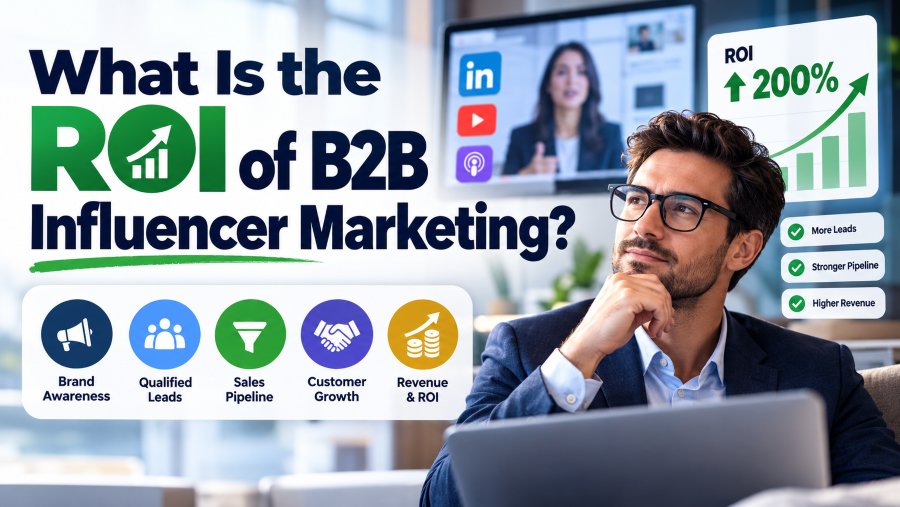
B2B influencer marketing is becoming an important growth channel for companies that need to build credibility, reach decision-makers, and influence complex buying decisions. But before investing in industry experts, creators, consultants, or thought leaders, marketers usually have one important question:
What is the ROI of B2B influencer marketing?
The short answer is that there is no universal ROI percentage that applies to every B2B influencer campaign. Returns depend on campaign costs, audience quality, deal size, sales cycle, influencer relevance, content quality, attribution method, and the business outcome being measured.
However, B2B influencer marketing can generate measurable returns through pipeline creation, qualified leads, customer acquisition, brand awareness, engagement, thought leadership, and revenue.
LinkedIn research highlights how influential creator content has become in B2B buying. In 2025, LinkedIn reported that 82% of B2B buyers said creator content directly influenced their buying decisions, while 87% preferred credible content from industry influencers.
Understanding ROI therefore requires looking beyond impressions and likes and connecting influencer activity to real business outcomes.
What Is B2B Influencer Marketing ROI?
B2B influencer marketing ROI is the financial return a business generates from the money invested in influencer marketing campaigns.
The basic formula is:
B2B Influencer Marketing ROI = (Return Generated − Campaign Cost) ÷ Campaign Cost × 100
For example, suppose a software company spends $20,000 working with several industry influencers.
The campaign generates $60,000 in attributable revenue.
The calculation would be:
($60,000 − $20,000) ÷ $20,000 × 100 = 200% ROI
A 200% ROI means the campaign generated $2 in profit above the original investment for every $1 spent.
But B2B attribution is rarely this simple.
A prospect might discover a company through an influencer’s LinkedIn post, watch a webinar two weeks later, read several blog posts, request a demo, speak with sales, and finally purchase three months later.
The influencer may have played an important role even though another channel received the final conversion credit.
That is why successful B2B companies measure both direct ROI and influenced revenue.
Why B2B Influencer Marketing ROI Is Different From B2C
B2C influencer campaigns often focus on immediate actions such as product purchases, coupon-code redemptions, app downloads, or website visits.
B2B buying journeys are considerably more complex.
A company purchasing a $50,000 software platform may involve employees from marketing, IT, finance, procurement, legal, security, and senior management.
Sales cycles may take weeks or months.
Influencers therefore contribute differently.
Instead of simply convincing someone to make an immediate purchase, a respected B2B influencer may:
- Introduce a brand to potential buyers
- Educate prospects about a problem
- Build credibility around a solution
- Validate a company’s expertise
- Generate marketing-qualified leads
- Increase webinar registrations
- Influence buying committees
- Support sales conversations
- Shorten consideration periods
- Generate opportunities and pipeline
This makes B2B influencer ROI a full-funnel measurement problem rather than simply a social engagement problem.
What Is a Good ROI for B2B Influencer Marketing?
There is no reliable universal benchmark defining a specific percentage as a “good” B2B influencer marketing ROI.
A positive return is obviously desirable, but businesses should establish benchmarks based on their own customer acquisition costs, average contract value, gross margins, lifetime value, and sales cycle.
For example, a SaaS company with an average customer lifetime value of $100,000 might consider spending $15,000 on a campaign that generates several high-quality opportunities extremely successful.
A company selling a $50 monthly product would require significantly more conversions to justify the same investment.
Instead of chasing a generic industry benchmark, compare influencer campaigns against other acquisition channels such as:
- Paid search
- LinkedIn advertising
- Content marketing
- Events
- Webinars
- Email marketing
- Organic social media
- Account-based marketing
The most useful question is not simply “What ROI did the influencer generate?”
It is:
“Did influencer marketing generate customers, pipeline, or influence more efficiently than alternative uses of the same budget?”
Does B2B Influencer Marketing Actually Work?
Growing research suggests that trusted experts and creators can have significant influence over B2B buyers.
LinkedIn’s 2025 research found that 59% of B2B buyers consume creator content on LinkedIn, 79% engage with creator content at least monthly, and 87% prefer credible content from industry influencers.
LinkedIn’s 2025 B2B Marketing Benchmark also reported that 55% of surveyed B2B marketers were already using influencer marketing or partnering with creators. Companies using influencer marketing were also more likely to expect marketing-budget increases than companies that did not use it.
The same LinkedIn/Ipsos research found marketers using creators reported performance advantages across multiple objectives, including customer engagement, brand awareness, thought leadership, qualified pipeline, and revenue growth. The gap between users and non-users reached as much as 39 percentage points for some objectives.
These figures should not be interpreted as a guaranteed ROI percentage. Instead, they show that creator partnerships are increasingly associated with measurable B2B marketing outcomes.
How to Calculate B2B Influencer Marketing ROI
Accurate measurement begins by calculating the complete campaign investment.
1. Calculate Total Campaign Costs
Include more than the influencer’s fee.
Your total investment might include:
Influencer fees + content production + paid amplification + software + agency fees + internal labor + landing pages + promotional costs
For example:
Influencer partnerships: $12,000
Video production: $3,000
Paid promotion: $4,000
Internal resources: $1,000
Total campaign investment: $20,000
2. Track Influencer-Generated Leads
Use attribution tools such as:
- UTM parameters
- Dedicated landing pages
- CRM campaign tracking
- Referral links
- Custom forms
- Promotional codes
- Marketing automation
- First-party website analytics
Tracking individual influencers separately helps identify which partnerships generate the highest-quality traffic and leads.
3. Track Pipeline Value
B2B marketers should pay particularly close attention to pipeline.
Suppose your campaign creates:
20 qualified leads
8 sales opportunities
$200,000 in pipeline
$60,000 in closed revenue
The $60,000 represents direct revenue, while the $200,000 pipeline indicates potential future impact.
4. Calculate ROI
If the campaign costs $20,000 and produces $60,000 in attributable revenue:
ROI = ($60,000 − $20,000) ÷ $20,000 × 100
ROI = 200%
However, continue monitoring open opportunities because additional revenue could appear months after the original campaign ended.
Important B2B Influencer Marketing Metrics
Revenue is the strongest measure of financial performance, but it should not be the only metric monitored.
Revenue Generated
Measure closed-won revenue connected directly or indirectly with influencer campaigns.
Influenced Pipeline
Track opportunities in which influencer content appeared somewhere within the buyer journey.
This is particularly important for enterprise sales.
Qualified Leads
Avoid measuring only lead volume.
Twenty decision-makers from relevant companies can be more valuable than 2,000 low-intent registrations.
Customer Acquisition Cost
Calculate:
Influencer CAC = Total influencer marketing cost ÷ Number of acquired customers
Compare it with CAC from paid advertising, organic search, events, outbound sales, and other acquisition channels.
Conversion Rate
Measure how many influencer-driven visitors become:
Subscribers → leads → qualified leads → opportunities → customers.
Engagement Quality
Comments from relevant CEOs, marketing leaders, engineers, procurement professionals, or industry specialists may be more valuable than hundreds of generic likes.
Brand Search Growth
Influencer campaigns can increase searches for your company, product, or leadership team.
Monitoring branded search volume before, during, and after major campaigns can reveal demand generation that direct-click attribution may miss.
Content Performance
Track:
- Video views
- Completion rates
- Click-through rates
- Downloads
- Webinar registrations
- Newsletter subscriptions
- Content shares
- Website sessions
For example, LinkedIn reported that its Thought Leader Ads generated 252% higher click-through rates, 62% lower cost per click, and 48% higher lead-form completion rates compared with single-image ads in its research.
Why Trust Has Such a Large Impact on B2B Influencer ROI
Trust is one of the most valuable elements of B2B marketing.
Decision-makers purchasing software, consulting, infrastructure, cybersecurity solutions, financial platforms, or professional services are taking significant organizational risks.
They therefore often trust practitioners and recognized industry experts more than conventional promotional messages.
LinkedIn research involving more than 1,700 technology buyers found that 87% preferred content from trusted industry influencers over branded sales messages.
Influencers effectively transfer part of their credibility to the company they discuss.
That credibility can make prospects more willing to:
Visit the company’s website, research the product, attend a webinar, download a report, request a demo, engage with sales, or include the company in a vendor shortlist.
This is where much of B2B influencer marketing’s long-term ROI originates.
B2B Influencer Marketing and Thought Leadership
Some of the most effective B2B influencers are not traditional social-media creators.
They are:
Industry analysts, founders, executives, consultants, subject-matter experts, researchers, engineers, marketers, developers, and experienced practitioners.
Their value comes primarily from expertise rather than follower count.
That distinction matters.
Edelman and LinkedIn’s B2B thought-leadership research found that 75% of surveyed decision-makers and C-suite executives had researched a product or service they had not previously considered after encountering a particular piece of thought leadership.
For B2B companies, working with credible experts who can educate a market may therefore produce more meaningful results than simply selecting influencers with the largest audiences.
How to Improve B2B Influencer Marketing ROI
Several factors can significantly improve campaign efficiency.
Choose Relevance Over Follower Count
A cybersecurity expert followed by 15,000 security professionals may produce substantially more business value than a general business creator with one million followers.
Audience relevance is critical.
Create Educational Content
B2B buyers usually want useful information rather than traditional influencer endorsements.
Strong formats include:
- Expert interviews
- Industry research
- Webinars
- Product walkthroughs
- Case studies
- Podcasts
- LinkedIn videos
- Tutorials
- Roundtable discussions
- Industry reports
The influencer should contribute genuine expertise instead of simply reading promotional talking points.
Build Long-Term Partnerships
One-off sponsored posts may generate temporary visibility.
Long-term partnerships repeatedly expose relevant audiences to the brand and can build stronger associations between the influencer’s credibility and your company’s expertise.
Repurpose Influencer Content
One influencer interview can become:
A webinar, blog article, LinkedIn clips, YouTube video, newsletter content, sales collateral, quote graphics, paid ads, and landing-page testimonials.
Repurposing increases the useful lifespan of the original investment.
Amplify Top-Performing Content
When an influencer post performs well organically, paid amplification can expand its reach among specific industries, job titles, companies, and decision-makers.
This hybrid approach combines influencer credibility with advertising precision.
Common B2B Influencer Marketing ROI Mistakes
One of the biggest mistakes is evaluating campaigns using only impressions.
Millions of impressions mean little if the audience contains few potential buyers.
Another problem is using last-click attribution exclusively.
If an influencer introduces a prospect to your company but the prospect later converts through Google Search, the search channel may receive all the credit.
Other common mistakes include:
Choosing influencers based only on follower count, targeting audiences that cannot purchase the product, failing to connect campaign data with CRM records, stopping measurement when a campaign ends, ignoring sales-cycle length, and measuring awareness campaigns purely by immediate revenue.
B2B companies need a measurement framework that reflects how their customers actually buy.
How Long Does It Take to See ROI From B2B Influencer Marketing?
The answer depends largely on the sales cycle.
Low-cost SaaS products may generate conversions within days.
Enterprise software, consulting, or infrastructure purchases can take several months.
This delay is one reason proving B2B marketing ROI remains challenging. LinkedIn research found that 78% of B2B CMOs said proving ROI had become more important, while 87% of marketers said measuring long-term campaign impact was becoming increasingly difficult.
Marketers should therefore measure influencer performance across multiple timeframes.
Evaluate immediate engagement first, followed by leads, pipeline creation, opportunity progression, customer acquisition, and eventually revenue.
Final Thoughts: What Is the ROI of B2B Influencer Marketing?
The ROI of B2B influencer marketing is the measurable business value generated from influencer partnerships compared with the total amount invested.
There is no single average ROI that every business should expect.
A successful campaign could generate revenue directly, create qualified pipeline, reduce customer acquisition costs, improve conversion rates, increase brand awareness, strengthen thought leadership, or influence buyers who convert months later through another channel.
To calculate financial ROI, use:
ROI = (Revenue Attributed to Influencer Marketing − Total Campaign Cost) ÷ Total Campaign Cost × 100
But do not stop there.
Track influenced pipeline, qualified leads, customer acquisition cost, conversions, deal progression, branded demand, and revenue over the complete B2B sales cycle.
Ultimately, the strongest B2B influencer programs do not treat influencers simply as advertising channels. They work with trusted industry voices to educate buyers, establish credibility, influence buying committees, and create demand.
When those activities are connected to CRM, attribution, pipeline, and revenue data, businesses can move beyond likes and impressions and determine the true ROI of B2B influencer marketing.
Frequently Asked Questions
What is the average ROI of B2B influencer marketing?
There is no universally accepted average ROI for B2B influencer marketing. Results vary according to industry, campaign cost, influencer relevance, deal size, sales cycle, content format, and attribution method.
How do you measure B2B influencer marketing ROI?
Calculate total campaign costs and compare them with attributable revenue using the formula (Revenue − Cost) ÷ Cost × 100. Also track qualified leads, influenced pipeline, opportunities, customer acquisition cost, conversions, and closed revenue.
Is B2B influencer marketing effective?
It can be highly effective when influencers have relevant audiences and genuine industry credibility. LinkedIn’s research indicates that creator content increasingly influences how B2B buyers research and evaluate products.
What metrics should B2B influencer campaigns track?
Important metrics include revenue, influenced pipeline, qualified leads, customer acquisition cost, opportunity creation, conversion rate, website traffic, engagement quality, branded searches, content downloads, and sales-cycle progression.
What type of influencers work best for B2B marketing?
Industry experts, practitioners, executives, consultants, analysts, founders, researchers, and other subject-matter experts usually provide the strongest fit because credibility and audience relevance are generally more valuable than follower count alone.
How can companies improve B2B influencer marketing ROI?
Choose highly relevant influencers, produce educational content, establish long-term partnerships, track campaigns through the CRM, repurpose influencer content across channels, amplify successful content, and measure performance throughout the complete sales cycle.