
If you are thinking about working with creators to promote your business, one of your first questions is probably: how much does influencer marketing cost?
The short answer is that influencer marketing can cost anywhere from under $100 for a small creator collaboration to $50,000 or more for a single campaign with a major influencer or celebrity.
That is a huge range, but there is a reason for it.
Influencer pricing depends on much more than follower count. The creator’s engagement, audience quality, platform, niche, content format, usage rights, campaign length, and even how quickly you need the content can all affect the final price.
For many small and growing brands, you don’t need a celebrity-sized budget either. Nano and micro influencers can often provide highly targeted access to audiences for hundreds rather than tens of thousands of dollars.
This guide explains what influencer marketing costs in 2026, what determines influencer rates, and how to build a realistic budget for your next campaign.
How Much Does Influencer Marketing Cost on Average?
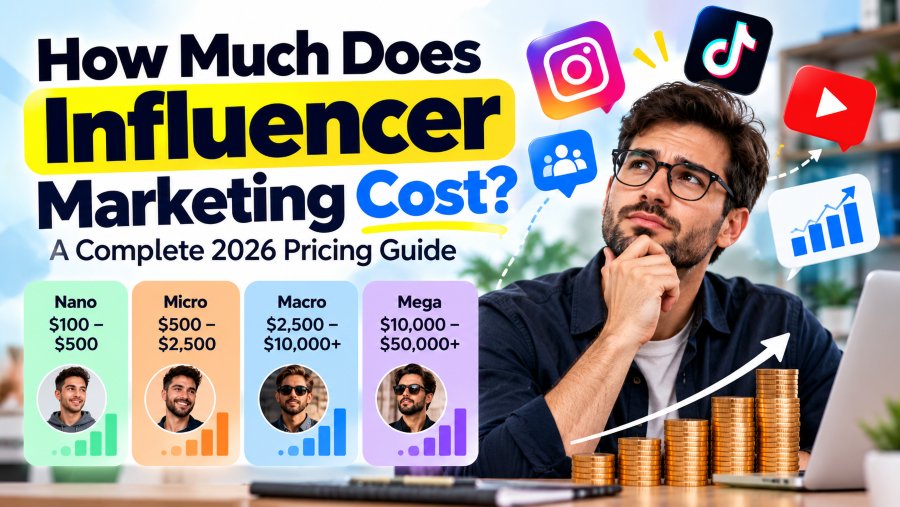
A reasonable starting point for influencer pricing in 2026 looks like this:
| Influencer Type | Approximate Followers | Typical Cost per Sponsored Post |
|---|---|---|
| Nano influencer | 1,000–10,000 | $100–$500 |
| Micro influencer | 10,000–100,000 | $500–$2,500 |
| Macro influencer | 100,000–1 million | $2,500–$10,000+ |
| Mega influencer | 1 million+ | $10,000–$50,000+ |
These numbers should be treated as budgeting benchmarks rather than fixed prices. Recent creator pricing research shows nano creators commonly charge around $100–$500 per sponsored post, while micro influencers can charge around $500–$2,500. Macro and mega creators can easily move into five-figure territory.
Some creators may charge much less. Others can charge significantly more.
A creator with 40,000 highly engaged followers in a profitable niche may command a higher fee than someone with 150,000 passive followers.
That is why follower count alone isn’t a good way to determine influencer value.
Influencer Marketing Cost by Creator Size
Understanding the different influencer tiers can make campaign budgeting much easier.
Nano Influencers
Nano influencers typically have between 1,000 and 10,000 followers.
They usually operate within small, focused communities and may have stronger personal relationships with their audiences.
A nano influencer might charge around $100 to $500 per sponsored post, although some newer creators may accept free products, commissions, or smaller payments.
For local businesses, startups, restaurants, niche ecommerce brands, and early-stage companies, nano influencers can be an affordable place to start.
Instead of spending $5,000 on one large creator, a brand could potentially work with several smaller creators and test which audiences respond best.
Micro Influencers
Micro influencers generally have between 10,000 and 100,000 followers.
Prices often fall somewhere between $500 and $2,500 per post, depending on platform, engagement, niche, and content requirements.
Micro influencers have become especially attractive to brands because they offer a useful balance between reach and audience relevance.
Someone producing content specifically about WordPress, fitness equipment, accounting software, skincare, or home renovation may reach fewer people than a mainstream celebrity, but their followers may be significantly more relevant to the product being promoted.
Macro Influencers
Macro influencers generally have audiences somewhere between 100,000 and one million followers.
Sponsored content can cost approximately $2,500 to $10,000 or more.
At this level, campaigns also become more professional.
Creators may have managers, agents, formal contracts, production requirements, and specific rules around revisions and content usage.
Macro creators make sense when your goal is large-scale exposure, brand awareness, product launches, or reaching a broad consumer audience quickly.
Mega Influencers and Celebrities
Mega influencers typically have more than one million followers.
Expect prices to begin around $10,000 and potentially exceed $50,000 for one deliverable. Celebrity collaborations can cost considerably more.
These campaigns are generally better suited to established companies with substantial marketing budgets.
For a small business focused primarily on conversions, however, putting the entire budget into one celebrity partnership is rarely the only option.
How Much Does Instagram Influencer Marketing Cost?
Instagram remains one of the biggest platforms for influencer campaigns.
Current estimates show extremely broad pricing ranges:
Nano influencers may charge around $25–$150 per post, while micro influencers can range from approximately $250 to $5,000. Larger accounts may command $5,000, $10,000, $25,000 or considerably more depending on their audience and reputation.
The type of Instagram content matters too.
An Instagram Story usually costs less than a professionally produced Reel. Reels require filming, editing, scripting, multiple shots, and sometimes original concepts.
A campaign containing one Reel, three Stories, and 30 days of advertising rights will therefore cost more than a simple organic image post.
How Much Does TikTok Influencer Marketing Cost?
TikTok influencer rates can also vary dramatically.
Current pricing estimates put nano creators at roughly $5–$200 per video, micro creators around $200–$1,200, and mid-tier creators around $1,200–$5,000. Larger TikTok creators may charge $5,000–$20,000 or more.
TikTok campaigns are often attractive because content can feel less like traditional advertising.
A creator demonstrating a product naturally within their normal style may generate more trust than a highly polished commercial.
But simplicity on screen doesn’t always mean simplicity behind the scenes.
Research, scripting, filming, editing, reshoots, captions, hooks, and trend research can all affect the rate.
How Much Does YouTube Influencer Marketing Cost?
YouTube sponsorships are often more expensive because long-form video takes considerably more work to create.
Current estimates place nano YouTube creator sponsorships around $200–$1,000, micro creators around $1,000–$10,000, and larger creators anywhere from roughly $9,000 to $50,000+, depending on audience size and campaign structure.
Pricing also depends on how your product appears.
A 60-second sponsored segment inside a longer video will normally cost less than an entire dedicated review.
For products requiring explanation, such as SaaS tools, electronics, financial services, software, courses, or B2B platforms, YouTube can be particularly useful because creators have time to demonstrate how the product actually works.
What Determines Influencer Marketing Cost?
There isn’t one universal influencer rate card.
Several factors influence what you actually pay.
Follower count matters, but it is only one part of the equation.
Engagement rate can be even more important. A creator whose audience regularly comments, saves, shares, clicks, and buys may be more valuable than someone with significantly more followers but little interaction.
Audience quality matters too. Brands should consider audience location, age, interests, purchasing power, and authenticity.
Then there is the content format. A basic image usually requires less production than a professionally filmed video.
Niche can dramatically change rates as well. Creators operating in finance, technology, B2B, beauty, health, or other commercially valuable markets may command premium pricing.
Usage rights are another major expense. If you want to take the influencer’s video and use it in your own Facebook, Instagram, TikTok, or YouTube advertisements, expect to pay additional licensing fees.
Exclusivity increases prices too. Asking an influencer not to promote competitors for three or six months limits their future earning potential, so they may charge more.
Finally, factors such as deadlines, multiple revisions, travel, professional production, props, additional platforms, or complicated approval processes can increase your total influencer marketing cost.
Don’t Forget the Costs Beyond the Influencer’s Fee
A common budgeting mistake is assuming the creator fee represents the entire campaign cost.
It doesn’t always.
You may also need to budget for product samples, shipping, influencer discovery software, agencies, campaign management, contracts, content editing, paid amplification, affiliate commissions, tracking technology, and usage rights.
Recent industry guidance suggests brands may allocate roughly 50%–60% of campaign budgets to creator fees and another 20%–30% toward usage rights and amplification, while reserving some budget for unexpected campaign expenses.
For example, imagine you have a $10,000 influencer marketing budget.
You might spend $5,500 on creators, $2,000 promoting the best-performing creator content through paid ads, $1,000 on usage rights and tools, and keep $1,500 available for additional creators, revisions, or unexpected opportunities.
That’s often more practical than spending the full $10,000 on creator fees alone.
Flat Fee vs. Commission-Based Influencer Pricing
You don’t always need to pay one fixed amount.
Influencer partnerships can use several payment models.
A flat fee gives the creator a predetermined payment for specific deliverables.
A commission model gives them a percentage of every sale generated through their link or discount code.
A product gifting arrangement provides free products instead of payment, although established creators may not accept gifting alone.
Brands can also use a hybrid model combining a smaller guaranteed fee with commissions.
For example, instead of offering $1,500 upfront, a brand might offer $700 plus 15% of tracked sales.
This reduces risk for the company while giving the creator an incentive to produce content that actually converts.
Performance-based compensation is becoming an increasingly important part of influencer marketing pricing as brands focus more heavily on measurable business results.
How Much Should a Small Business Spend on Influencer Marketing?
There is no minimum amount required to start.
A small business could test influencer marketing with $500–$2,000 by partnering with a handful of nano creators.
A growing ecommerce or SaaS business might dedicate $3,000–$10,000 to a more structured campaign involving several micro influencers.
Larger companies may invest tens or hundreds of thousands of dollars across creator fees, production, paid media, and long-term partnerships.
The important thing is not simply spending more.
It is learning which creator, message, content format, and audience produce the best results.
Starting with smaller experiments often gives you more useful information than putting your entire budget into one major influencer.
How to Calculate Whether an Influencer Is Worth the Cost
Suppose you pay a creator $2,000.
The campaign generates 60 purchases, and your average profit per new customer is $70.
That gives you $4,200 in initial profit generated from a $2,000 creator fee.
But direct sales are not the only measurement.
You might track:
- Revenue and purchases from unique links or discount codes
- Cost per acquisition
- Website traffic
- Email sign-ups
- App installs or trial registrations
- Engagement and video views
- New followers
- Content production value
- Assisted conversions and future purchases
For SaaS products in particular, customer lifetime value can be more important than the customer’s first payment.
If a $50 influencer acquisition becomes a customer who generates $600 in lifetime profit, that campaign can still be highly successful.
Is Influencer Marketing Expensive?
Influencer marketing can be expensive, but it doesn’t have to be.
What makes it different from traditional advertising is the range of entry points.
A small brand can collaborate with creators who have a few thousand targeted followers, while multinational businesses can build campaigns around celebrities with millions.
That flexibility makes influencer marketing accessible across very different budgets.
The real question isn’t simply, “How much does influencer marketing cost?”
A better question is:
“How much should we pay to reach the right audience and generate a profitable result?”
When you evaluate campaigns from that perspective, the cheapest influencer isn’t automatically the best deal—and the biggest influencer isn’t automatically the best investment.
Frequently Asked Questions
How much does influencer marketing cost per post?
Influencer marketing can range from under $100 to more than $50,000 per sponsored post. Nano creators typically sit at the lower end, while macro influencers, mega influencers, and celebrities command significantly higher rates.
How much do micro influencers charge?
Micro influencers with approximately 10,000–100,000 followers commonly charge several hundred to a few thousand dollars per sponsored deliverable. Recent 2026 benchmarks place many around $500–$2,500 per post, although actual quotes vary substantially.
Is influencer marketing affordable for small businesses?
Yes. Small businesses can start with nano and micro influencers instead of expensive celebrities. A campaign involving several targeted smaller creators may cost a few hundred to several thousand dollars.
Which influencer platform costs the most?
YouTube often commands higher fees because long-form videos require more research, filming, editing, and production. However, premium Instagram and TikTok creators can also charge substantial amounts.
Can you pay influencers based on sales?
Yes. Affiliate commissions and performance-based compensation are common. Some campaigns combine a guaranteed creator fee with a percentage of sales generated through tracked links or discount codes.
Why do two influencers with the same follower count charge different prices?
Follower count doesn’t show the complete value of an audience. Engagement, niche, audience demographics, past performance, production quality, platform, usage rights, and exclusivity can all influence pricing.
Final Thoughts
So, how much does influencer marketing cost in 2026?
For smaller creators, you might spend only a few hundred dollars. Established micro influencers commonly cost hundreds or a few thousand dollars per collaboration. Large creators can cost $10,000 or more, while major celebrity partnerships can move far beyond that.
But influencer marketing shouldn’t be purchased based on follower count alone.
Look at who actually follows the creator, how engaged those people are, whether they match your ideal customer, how strong the creator’s content is, and what measurable results the partnership can produce.
For most brands, especially those running influencer campaigns for the first time, starting with several well-matched nano or micro influencers is often more useful than putting the entire budget behind one large name.
Test small, track conversions, identify your strongest creators, and then increase spending where the numbers support it.
That is how influencer marketing becomes less of a guessing game—and more of a measurable growth channel.